Participles and gerunds and infinitives, O my!
In the musical “The Wizard of Oz,” Dorothy, the Scarecrow, and the Tin Man are on a journey to the Emerald City to see the Wizard. Along the way, they enter a dark forest. Dorothy asks about the wild animals they might meet, and the Tin Man informs them that they might meet lions, tigers, and bears. Dorothy responds, “Lions and tigers and bears, Oh my!” They begin skipping through the forest, repeating Dorothy’s phrase. Suddenly, they encounter a lion.
Nothing sounds scarier to non-native users of English than the three words participles, gerunds, and infinitives. We call them “verbals.” They look like verbs, but they aren’t verbs. Yes, they can be tricky, which can make them a little scary, but in this post, we will discover that they aren’t as scary as they seem. Just as Dorothy, the Scarecrow, and the Tin Man were at first afraid of the lion, once they got to know him, they discovered he wasn’t so scary after all. He was actually a big coward. So let’s get to know these lions and tigers and bears of grammar, shall we?
Participles
In English, we have the present participle and the past participle. These are parts of verbs. You learn these when you learn the principle parts of verbs. For example, let’s take the verb “to inspire.” This verb means to fill someone with the ability to feel something or the desire to do something, especially something creative.
The principle parts of this verb are as follows:
Present: inspire(s)
Present participle: inspiring
Past: inspired
Past participle: inspired
We use the present participle to create the continuing tenses with the auxiliary verb “to be.” For example, “His words are inspiring me to change my life” (present continuing tense). We use the past participle to create the perfect tenses with the auxiliary verb, “to have.” For example, “His words have inspired me to change my life” (present perfect tense).
The present and past participles are used for more than just creating these verb tenses. They are also used all by themselves as adjectives.
The present participle – characteristics
The present participle is used to create adjectives that describe the characteristics of a person, place or thing. I can use the word “inspiring” to describe a movie I saw. For example, “The NeverEnding Story was a very inspiring movie.”
Now, it’s your turn. What person, place, or thing did you find inspiring?
The past participle – feelings
The past participle is used to create adjectives that describe a person’s feelings. I can use the word “inspired” to describe how I felt about the movie. For example, “After I watched The NeverEnding Story, I felt inspired to read more books.”
It’s your turn again. How did that inspiring person, place, or thing make you feel?
Gerunds
Gerunds are a special type of present participle that act as nouns. Examples of gerunds include walking, swimming, running, studying, drinking, and sleeping. As you can see, they are all words that express things people do – or activities. An activity is a noun. Gerunds name activities; therefore, gerunds are nouns.
Gerunds can be used by themselves. For example, “Swimming is my favorite form of exercise.” Gerunds can also begin noun phrases. For example, “Swimming in the river is my favorite form of exercise.” Now, the gerund is followed by “in the river” – an adverb prepositional phrase telling “where.” The gerund plus the prepositional phrase that follows it makes a gerund phrase. In these two examples, the gerund or gerund phrase is the subject of the sentence.
Okay, it’s your turn! What is your favorite form of exercise? Where do you like to exercise?
Gerunds and gerund phrases can also function as objects in sentences. For example, “I like swimming” and “I like swimming in the river.” Give it a try! What do you like doing? Where?
In addition, gerunds are often used as the objects of prepositions, such as in this sentence: “I like to wear shorts and a tank top for swimming.” What do you like to wear for your favorite activities?
What can be tricky is that sometimes a gerund can look like part of a continuing tense verb. Check out this sentence: “Your favorite hobby is reading.” The two words “is reading” look like the present progressive tense, doesn’t it? But is the word “reading” part of an action word, or is the word “reading” simply naming an activity?
Is your favorite hobby off reading somewhere? No, of course it’s not. Hobbies can’t read.
Infinitives
Infinitives are the root form of a verb preceded by the word “to.” Examples of infinitives are as follows: to run, to stop, to swim, to eat, to sleep, and to walk. Infinitives can function as adjectives, adverbs, or nouns. They can work alone or in phrases. Some examples follow.
“I have things to do.” The infinitive is an adjective describing the noun “things.”
“I went home to get my passport.” The infinitive phrase is an adverb telling why.
“I planned to go on a picnic, but it rained.” The infinitive phrase is a noun (the direct object).
Do I use a gerund or an infinitive?
This is the trickiest part when it comes to gerunds and infinitives. There are rules to follow (“to follow” is an infinitive functioning as an adjective 😊).
Use gerunds as subjects.
Infinitives aren’t used as subjects very often – especially in verbal language. You might see them used as subjects in formal writing or in poetry. For example, in his play Hamlet, Shakespeare wrote, “To be or not to be – that is the question.”
When using gerunds or infinitives as objects, the meaning changes with some verbs.
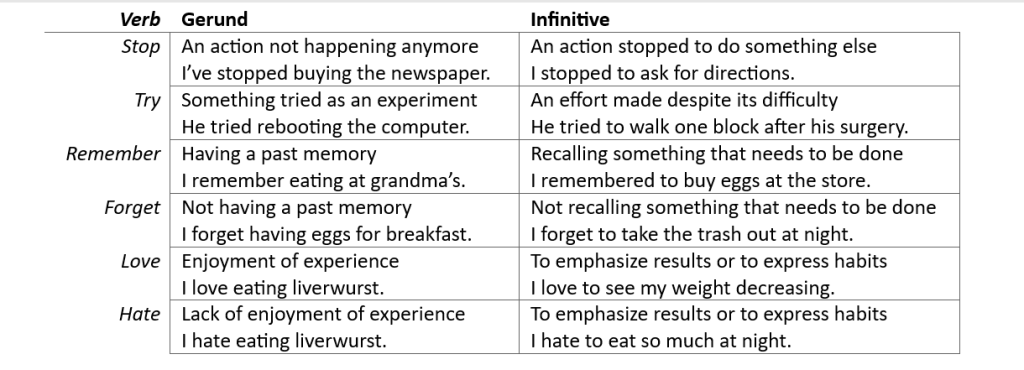
“I stopped smoking” has a very different meaning from “I stopped to smoke.” The first expresses an action not happening anymore. The second expresses an action stopped to do something else. Below is a table containing more verbs that change meaning depending on whether a gerund or infinitive follows.
Some verbs are followed by infinitives.
For example: “I needed using to use the restroom, so I waited entering to enter a stall.” Below is a table with more verbs usually followed by infinitives.

Some verbs are followed by gerunds.
For example: “You should consider to take taking a break since you practiced to play playing the piano for over an hour.” Below is a table with more verbs usually followed by gerunds.

Infinitives follow adjectives.
For example: “It’s not easy learning to learn a language.” Since “easy” is an adjective, an infinitive must follow. Here is another example: “John wasn’t tall enough reaching to reach the apple.” Since “tall” is an adjective (“enough” is an adverb modifying “tall”), an infinitive must follow.
Infinitives are used after certain verbs when a personal pronoun is the object.
For example: “We asked her giving to give us money.” Below is a table with more verbs followed by infinitives when a personal pronoun is the object.

Use gerunds as objects of prepositions.
Gerunds are generally used as objectives of prepositions. For example: “He uses a cane for to walk walking.” However, infinitives can be used after some prepositions. For example: “The show is about to start.”
Are you still scared?
I hope that this post has taken some of the scariness out of this tricky area of grammar. As with all areas of tricky English, the more you practice using participles, gerunds, and infinitives, the more comfortable you will feel. The charts in this post do not include all of the verbs in the English language that belong in each category. You will learn additional verbs for each as you become more experienced with the English language. Remember that learning another language is a journey. Try to relax and enjoy it!
 Acorn Test Prep