
Talking about the future in English is one of the most common challenges for learners. Students often ask: Should I use will or going to? The answer depends on the situation.
Let’s take a look at the difference between will and going to. I’ll give you some clear examples, and include a short practice quiz at the end to test your understanding.
What Is the Future Tense in English?
English does not have a single “future tense” like some languages. Instead, we use different forms to express the future. The two most common are:
- Will + base verb → I will call you.
- Going to + base verb → I’m going to call you.
Many students think that these two forms mean basically the same thing—that we can use them interchangeably—but we cannot. They suggest different things about when decisions were made and the evidence we have to support our predictions.
When to Use Will in English
We use will in a few key situations:
1. Decisions made at the moment of speaking
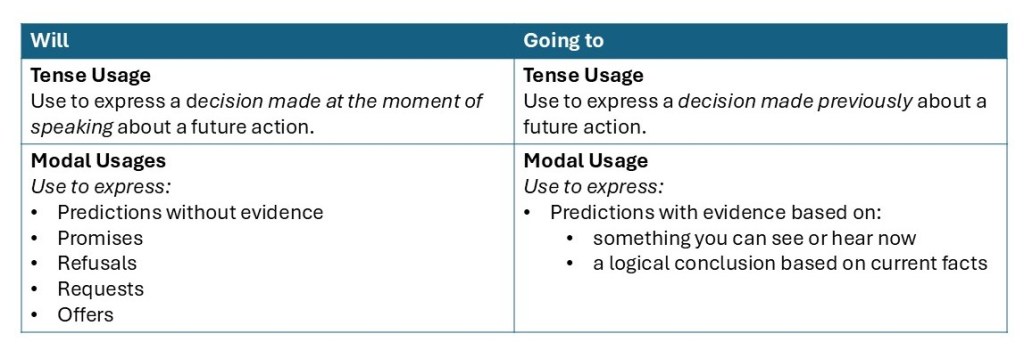
We use will to express a decision we are making right now about a future action.
- I’m hungry. I will order pizza. → I’ve just noticed I’m hungry, so I’m making the decision right now to order pizza.
- We’re lost. I will check the map. → I’ve just realized we’re lost, so I’m making a decision right now to check the map.
2. Predictions based on opinion or belief
We use will when we’re stating our beliefs or opinions without evidence. This usage of will to express a prediction is considered modal because it expresses a degree of certainty rather than a future time.
- I think it will rain tomorrow. → This is just my belief; I haven’t checked the weather.
- She will do well in her interview. → This is just my opinion; I don’t have any proof.
3. Promises, refusals, requests, offers
The use of will in these situations is also considered modal because they express a degree of willingness or intent rather than a future time.
- Don’t worry, I will call you later. → I’m promising to call you.
- I won’t let you borrow my car. → I’m refusing to let you borrow my car.
(Remember: won’t is the negative form of will. It’s more natural than will not.) - Will you help me with my homework? → I’m making a request.
- I will help you with your homework. → I’m offering to help you.
When to Use Going To in English
1. Intentions or plans made before the moment of speaking
We use going to to express a decision we made previously about a future action.
- I’m going to start exercising next week. → I have already made up my mind.
- They’re going to move to a new apartment. → They’ve made this plan earlier.
2. Predictions based on present evidence
We use going to to express predictions with evidence. The evidence must be signs that something is about to happen because you can see something, hear something, or draw a logical conclusion from current facts.
- Look at those clouds. It’s going to rain. → The clouds are evidence I’m seeing now.
- That car is driving too fast. It’s going to crash. → I can see the car right now, and it’s traveling too fast to be safe.
“Will” vs. “Going to” Review
Scenario: Lunchtime!
Context: You’re sitting at your desk at work. It’s lunchtime, and you co-worker walks in.
Coworker: “What are you doing for lunch?” → We use the present continuous to ask people about their future plans.
You: “Hmmm, I don’t know. I think I’ll get some pizza.” → You just decided this now.
Coworker: Okay, I’m going to get some Chinese food takeout and eat lunch in the park. → Your coworker made this decision earlier.
You: You might not want to do that. It’s getting dark out there. I think it’s going to rain. → This is prediction based on evidence you can see – “it’s getting dark out there.”
Coworker: Maybe you’re right. I’ll eat in my office. You know what? It will probably rain tomorrow. It always rains when I have plans for the weekend. → Your coworker is making a prediction based on his or her belief about being unlucky.
Quick Practice: Will or Going To?
Fill in the blanks with will or going to:
- _______ you help me with the laundry?
- I _______ study English at the university this fall.
- Look at that ice! He _______ slip and fall!
- Oh look! There’s a hole in my sock. I _______ buy a new pair of socks tomorrow.
- He _______ travel to England this summer.
Answers:
1. will – This is a request.
2. am going to – This decision was made previously.
3. is going to – This is a prediction based on evidence (seeing the ice).
4. will – This decision was made spontaneously upon seeing the hole in my sock.
5. is going to – This decision was made previously.
Note: While it is possible that #2 and #5 could be spontaneous decisions, it is more probable that they were decisions made previously.
Final Tips for Using Will and Going To
- Use will for spontaneous decisions, personal predictions, and promises.
- Use going to for plans and predictions with evidence.
That’s It!
That’s it for this edition of Tricky English. If you like my blog, don’t forget to subscribe! Also, check out my Facebook page at https://www.facebook.com/acorntestprep.
 Acorn Test Prep